“How much will it cost?” The answer changes as the drawings move forward. That’s what estimate classes are for: telling you, at each stage, how much accuracy you can reasonably expect. Used properly, they prevent bad surprises at tender time.
The four classes at a glance
The ranges below are the ones generally associated with the estimate classes of the Canadian Institute of Quantity Surveyors (CIQS). Some public owners use their own definitions, so always check the ones that apply to your project.
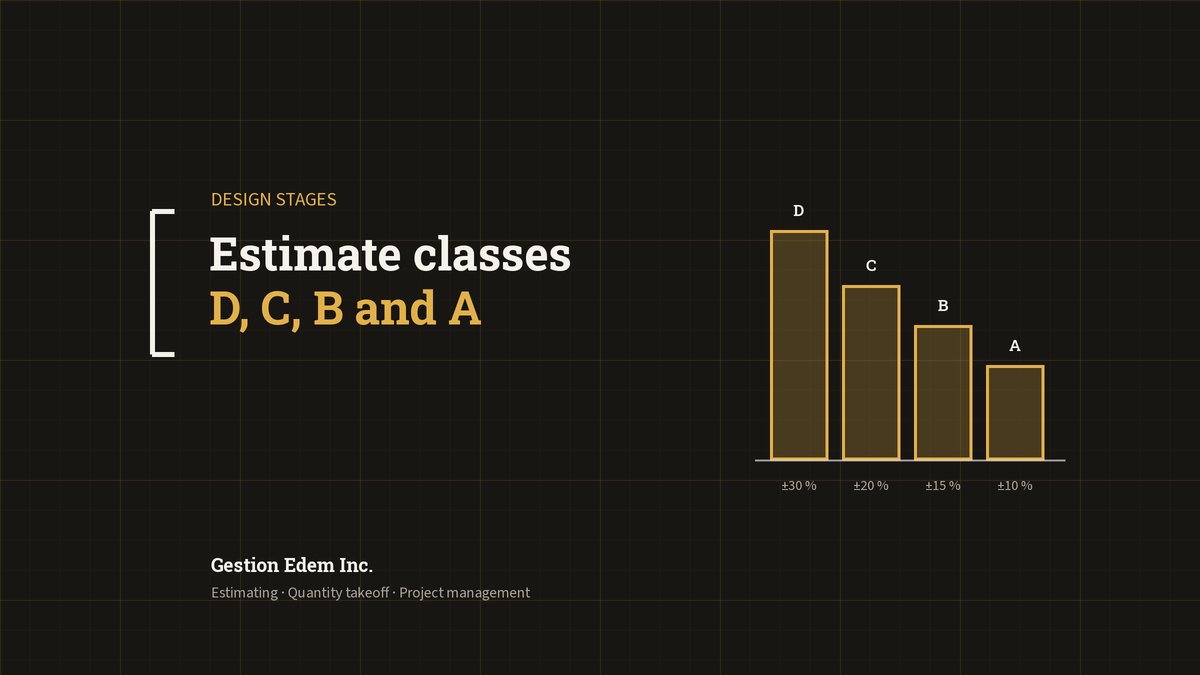
- Class D, sketch or feasibility: about ±20 to ±30%. Based on costs per square metre and general assumptions. It tells you whether the project is worth taking further.
- Class C, concept or preliminary: about ±15 to ±20%. The major systems and some key quantities are known. It sets the design budget.
- Class B, preliminary drawings and specs: about ±10 to ±15%. Quantities are taken off by system. It confirms the project fits the budget envelope.
- Class A, complete documents: about ±5 to ±10%. Drawings and specs ready for tender, detailed quantities. This is the control estimate used to assess the bids.
Reading the range correctly
A Class D estimate of $10M doesn’t mean “$10M”. It means “probably somewhere between $7M and $13M”. Presenting a Class D number as a firm price is the most common source of “surprise” overruns. The right habit: always show the class next to the amount, along with the assumptions and exclusions.
What moves you from one class to the next
- the definition of the program and floor areas;
- the choice of systems: structure, envelope, mechanical, electrical;
- the geotechnical study, often decisive for foundations and civil work;
- the delivery strategy: phasing, occupied premises, construction season.
For architects and engineers
Your client expects a number at every milestone. An independent estimate at each class lets you weigh your design choices knowing what they cost, and get to tender without cutting the project at the last minute. That’s what we do for architects and engineers.
For project owners
A Class D budget should never be the basis for a final borrowing by-law. Plan at least one Class B update, then a Class A control estimate before going to tender. See our page for project owners.
Which class do you need before going to tender?
A Class A, prepared from complete drawings and specifications, ideally after the last major addendum.
Can you skip a class?
Yes, but you lose a checkpoint. The more complex the project, the more each estimating stage is worth its cost.
Source for the ranges: Noble QS, Class A, B, C and D estimates according to CIQS.