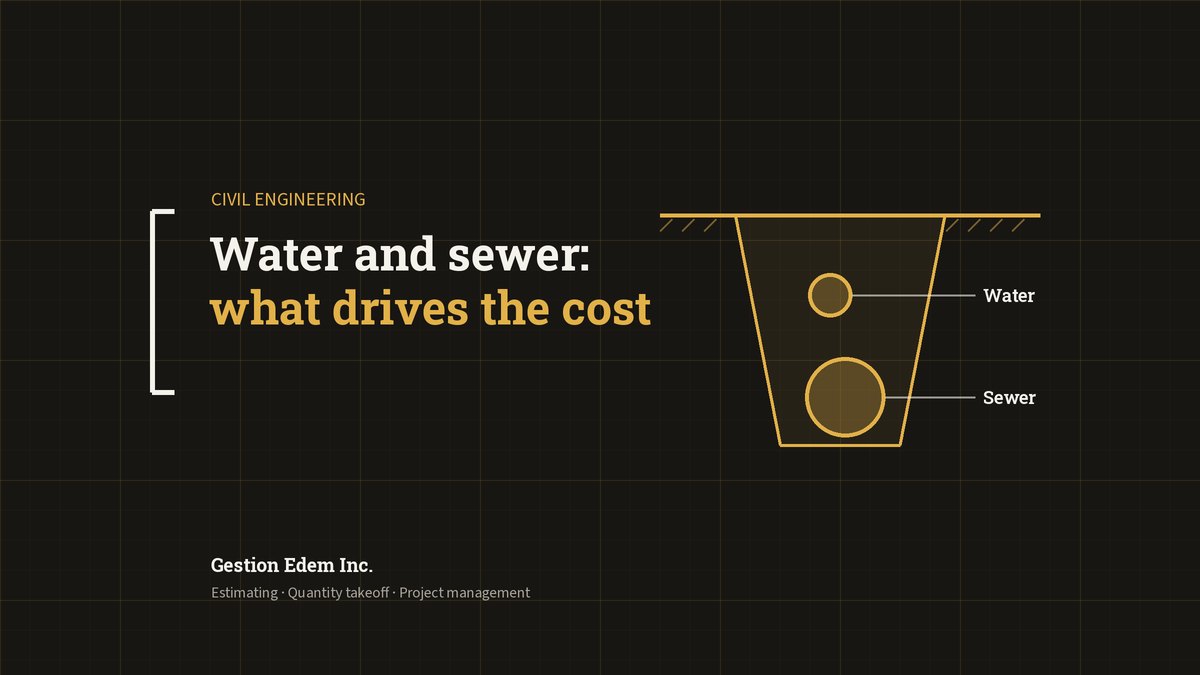
On a street reconstruction with pipe replacement, the budget rarely blows up because of the pipe. The damage comes from rock sitting higher than expected, water filling the trench, contaminated soil to haul away, or months of traffic control. Whether you’re a municipality preparing a tender or a contractor putting a bid together, those are the items we look at first.
What’s in a water and sewer bid form
The bid form roughly follows the order of the work:
- Mobilization, signage and traffic control
- Temporary water supply to keep residents connected
- Excavation, rock, trench boxes and dewatering
- Water mains, sanitary sewers and storm sewers (PVC, ductile iron, reinforced concrete)
- Manholes, catch basins, valves, fire hydrants and service connections
- Pressure and leakage tests, disinfection, CCTV inspection
- Backfill, compaction and road base
- Paving, curbs, sidewalks and landscaping restoration
Pipe is measured by the linear metre, manholes and service connections by the unit, excavation and materials by the cubic metre or the tonne. If the quantity takeoff is off, the whole estimate goes sideways.
The items that push the price up
Rock. A geotechnical report is a few boreholes, not a guarantee. Between two boreholes, rock can come up higher than expected. We check whether the bid form carries a unit price for rock and whether the planned quantity makes sense.
Water. With a high water table, you pump, sometimes install well points, and the trench moves slower. We go by the water levels measured in the report, not by gut feeling.
Soil. Excavated soil is managed according to its characterization, and contaminated soil in Quebec now falls under a mandatory traceability system. Between trucking and the disposal site, the bill climbs fast.
Depth. The deeper the pipe, the more trench boxes or side slopes you need, and the fewer metres you lay per day. On a narrow street with gas, power and telecom already in the ground, it’s slower still.
Life on the street. Water, sewer, driveway access and garbage pickup all have to keep going during the work. That takes planning, and it has a cost.
Read the specs before putting a price on it
Many Quebec municipalities base their water and sewer pipe work on the BNQ 1809-300 standard, then add their own special provisions. Those provisions are often what changes the price: imposed work sequence, allowed working hours, specified materials, extra testing. We read them in full before giving a number.
For municipalities: the control estimate
Before going to tender on a major contract, a Quebec municipality must establish an estimate of the price. An independent control estimate validates the budget and tells you whether the bids you receive are reasonable.
For contractors: bidding without getting caught
When the tender comes out on SEAO, deadlines are often tight. We do the takeoff, compare our quantities with the bid form, flag the risks (rock, water, soil, traffic) and hand you a detailed estimate you can build your price on. For excavation only, see our excavation and earthwork estimating page.
A project example
Among our civil projects: street reconstruction in Wendake. All our infrastructure services are on our civil engineering estimating page.
Your water and sewer project
Send us your drawings and specifications at info@gestionedem.com or call 581-999-5503. We get back to you within 48 hours with our service proposal, anywhere in Quebec. You can also use our contact page.